Are Kegerators Worth It? A Cold, Honest Cost Breakdown
Whether a kegerator pays for itself comes down to how much you drink, what you drink, and whether you value fresh draft beer at home enough to do the upkeep.
Are kegerators worth it? For a household that goes through beer steadily and likes it cold, fresh, and on tap, the answer is usually yes over a few years. A kegerator trades a few hundred dollars up front, plus modest running costs, for draft-quality beer at home and a lower price per pint than cans or bottles once you buy in keg volume. But it is not a money-saver for occasional drinkers, and it carries real chores: cleaning lines, swapping CO2, and keeping the temperature dialed in. This guide walks through the actual numbers and the trade-offs so you can decide before you spend.


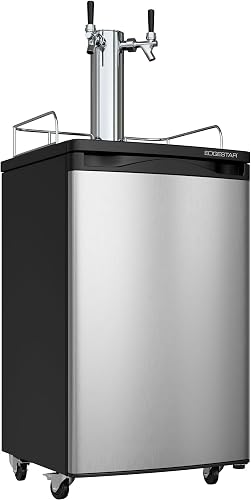
The short answer
A kegerator is worth it if three things are true. First, you drink enough beer that a half-barrel or two of pony kegs disappears in a reasonable window, roughly a couple of months, so it stays fresh. Second, you value draft beer at home enough to handle basic upkeep. Third, you plan to keep the unit for several years, which is what lets the up-front cost average down. If you drink a six-pack a month, sample lots of different styles, or want zero maintenance, the math and the hassle both work against you, and a good beverage fridge stocked with cans is the smarter buy. Everyone else lands somewhere in between, and the rest of this guide helps you find your spot.
What you actually pay up front
The kegerator itself is the obvious cost, and home units span a wide range depending on whether you want a single tap, dual taps, a stainless cabinet, or a commercial-grade build. Most freestanding home models land in the several-hundred-dollar bracket. Beyond the cabinet, a complete first setup usually includes the CO2 tank, a regulator, the coupler that matches your keg type, beer and gas lines, and the faucet, though many kegerators ship as a kit with these included, so read the listing carefully before buying parts twice. Budget a little extra for a cleaning kit and a refundable keg deposit at your local store. The point is that the sticker price is not always the all-in price, and a kit that bundles the tap hardware is often the better value than a bare cabinet you have to outfit yourself.
Cost per pint: where kegerators win
This is the heart of the case. Buying beer by the keg is cheaper per ounce than buying the same beer in cans or bottles, because you are not paying for all that packaging or the retail markup on small units. A standard half-barrel keg holds the equivalent of well over a hundred and fifty twelve-ounce servings, and a quarter-barrel or sixth-barrel scales down from there. When you divide the keg price by the number of pints it pours, the per-pint cost of mainstream and craft beer usually undercuts the canned price, sometimes substantially for house-style lagers. The catch is volume: that savings only materializes if you actually drink the keg before it goes flat or stale. Buy more beer than you drink and the discount evaporates along with the freshness.
The running costs nobody mentions
A kegerator is a small refrigerator with a compressor, so it sips electricity year-round much like a compact fridge or beverage cooler; on most home power rates that is a modest annual figure, not a budget-buster, but it is not zero. Then there is CO2: a tank lasts through several kegs before it needs a refill, and refills are inexpensive, but they are a recurring errand. Cleaning supplies and the occasional replacement line or washer add a little more. None of these costs are large on their own, yet they are the difference between the rosy keg-math and reality. When you tally electricity, CO2 refills, and consumables against the per-pint savings, a regular drinker still comes out ahead; a light drinker does not, because the fixed running costs get spread across too few pints.
The upkeep you are signing up for
Worth it is partly a question of effort, not just money. Beer lines need regular cleaning to avoid off-flavors and buildup, ideally between kegs and at least every couple of weeks during a long pour, which is a fifteen-minute job with a cleaning kit but a job all the same. You will learn to set the regulator pressure and fridge temperature so beer pours with the right amount of foam instead of all head or flat. You will swap CO2 tanks and couple new kegs. None of this is hard, and many owners enjoy the ritual, but if the idea of any of it sounds like a chore you will resent, factor that in honestly. A kegerator rewards people who treat it as a small hobby and frustrates people who wanted a vending machine.
When a beverage fridge makes more sense
If you read the last two sections and winced, you may not want a kegerator at all, and that is a perfectly good outcome. A beverage fridge stocked with cans and bottles gives you cold drinks on demand with no lines to clean, no CO2 to refill, and the freedom to keep ten different styles on hand instead of committing to a single keg. It also suits homes where variety matters more than draft texture, or where you simply do not drink enough beer to justify keg volume. The trade-off is a higher price per drink and no draft pour. If that sounds like your household, browse our beverage fridge picks instead; if you still want draft beer at home, read on.
How to decide quickly
Run through four questions. How much beer do you and your household realistically drink in two months, and would a keg of that size empty in time? Do you mostly drink one or two styles you would happily keep on tap, or do you crave constant variety? Are you willing to spend fifteen minutes cleaning lines on a schedule and run the occasional CO2 errand? And will you keep the unit for several years so the up-front cost averages down to pennies on each pint? If you answered yes to most of these, a kegerator is genuinely worth it and will likely pay for itself while pouring better beer than any can. If you hesitated, a beverage fridge is the lower-effort, lower-commitment choice. Once you have decided a kegerator is right, our ranked picks let you compare real models by tap count, capacity, and price so you can buy the one that fits your space and your pour.
Frequently asked questions
Does a kegerator save money compared to buying cans or bottles?
It can, for steady drinkers. Buying by the keg lowers the price per pint versus small packs, but you only capture that savings if you finish the keg fresh and keep the unit long enough to spread out the up-front cost.
How much does it cost to run a kegerator?
A kegerator uses electricity like a small fridge, which is a modest annual cost on typical home rates, plus occasional CO2 refills and cleaning supplies. None are large individually, but together they offset some of the keg savings.
How much maintenance does a kegerator need?
Plan to clean the beer lines regularly, ideally between kegs and at least every couple of weeks, and to set the CO2 pressure and temperature for a clean pour. It is light, recurring upkeep rather than a one-time setup.
Should I get a kegerator or a beverage fridge?
Choose a kegerator if you drink enough of one or two styles to keep a keg fresh and want draft beer at home. Choose a beverage fridge if you value variety, want zero line-cleaning, or drink too little to finish a keg in time.