How to Measure for a Refrigerator Before You Buy
The five measurements that decide whether a refrigerator slides into place or gets sent back to the store.
Most returned refrigerators were never the wrong fridge. They were the wrong size for the space, by an inch or two that nobody checked first. Before you fall for a finish or a feature, the only number that matters is whether the box fits the opening, clears the cabinets, and lets the doors actually open.
This guide walks you through every measurement that matters, in the order a careful buyer takes them: width, height, depth, door swing, and the clearances the cooling system needs to breathe. Take fifteen minutes with a tape measure now and you will shop with a fixed target instead of a guess.

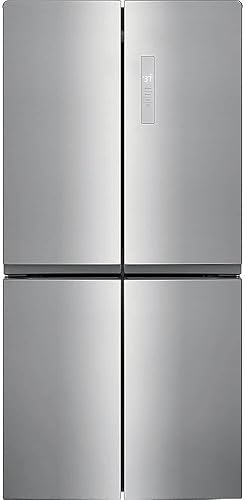

Measure the opening, not the old fridge
Your current refrigerator is a clue, not a spec. Pull it out and measure the empty space it lived in. For width, measure between the cabinets or walls at the top, middle, and bottom of the gap and write down the smallest number, since openings are rarely perfectly square. For height, measure from the floor to the underside of the upper cabinet or soffit. For depth, measure from the back wall to the front edge of the surrounding cabinets. These three numbers are your hard ceiling: a fridge must come in under each one, not match it exactly.
Add clearance so the fridge can breathe and slide in
A refrigerator that fills the opening to the millimeter will overheat and may not go in at all. As a working rule, leave roughly an inch of air on each side, an inch or so on top, and a couple of inches at the back for the coils and power cord. Manufacturers publish their own minimum clearances, so always confirm against the spec sheet for the exact model you are considering. The practical takeaway: subtract those clearances from your opening before you compare it to any listed dimension, then shop to that adjusted number.
Watch the door swing and handle protrusion
Width and height get all the attention, but door swing is what trips people up. A French-door or side-by-side model needs room for both doors to open without hitting a wall, an island, or the oven door across a galley kitchen. Check that crisper drawers and bins can pull all the way out when the door is at ninety degrees. Also account for handles, which can add an inch or more to the listed depth. If the fridge sits near a corner, confirm the door clears the adjacent cabinet before the hinge binds.
Counter-depth versus standard depth
Depth decides how the kitchen feels. A standard-depth refrigerator typically juts out several inches past the countertop, which buys you more interior space but a bulkier look. A counter-depth model sits nearly flush with the cabinets for a built-in appearance, trading some capacity for a cleaner sightline. Neither is better in the abstract. Measure how far your counters project, decide whether a protruding fridge will block a walkway or doorway, and let the room make the call rather than the showroom.
Plan the delivery path, not just the kitchen
A fridge that fits its final spot can still fail at the front door. Measure every doorway, hallway turn, and stair landing between the truck and the kitchen, and compare the narrowest point to the fridge's depth, since delivery crews usually bring large units in on their side. Note the width of doorframes, and remember that taking a door off its hinges can free up an extra inch or two if you are close. Tight entries are the single most common reason a delivery gets refused, so map the whole route before you order.
Match your measurements to a real shortlist
Once you have your adjusted width, height, and depth, shopping gets simple: you are filtering by fit first and features second. Compact and apartment-friendly models suit tight openings and pass-throughs, while full-size French-door and side-by-side units need both the cavity space and the door-swing room. Our refrigerator picks list each model's footprint and configuration so you can line them up against your numbers, instead of decoding a wall of unfamiliar dimensions on a retail page.
Frequently asked questions
How much clearance does a refrigerator need on the sides and back?
A common starting point is about an inch of air on each side and top and a couple of inches at the back for coils and the cord, but the exact minimum varies by model. Always confirm the figures on the manufacturer's spec sheet for the unit you plan to buy.
What is the difference between counter-depth and standard-depth refrigerators?
Counter-depth models sit nearly flush with your cabinets for a built-in look and slightly less interior space, while standard-depth models project several inches past the counter and generally hold more. Measure how far your counters stick out to decide which suits the room.
Will my new refrigerator fit through the door?
Measure the narrowest doorway, hallway, and stair turn on the path to the kitchen and compare it to the fridge's depth, since crews often carry units on their side. Removing a door from its hinges can add an inch or two of clearance if you are close.
Should I measure my old fridge or the space it sits in?
Measure the space. Your old fridge tells you what fit before, but the opening, cabinets, and clearances are what a new model must actually satisfy, so the empty opening is the number to shop against.