The Small Kitchen Refrigerator Guide: Fit More Without Overpaying
A tight kitchen doesn't mean settling for a dorm fridge, here's how to find the most usable cold storage that actually fits the space you have.
In a small kitchen the refrigerator is the one appliance you can't shrink without consequences, so the goal is maximum usable storage in the smallest sensible footprint. That means measuring honestly, choosing a configuration that suits a narrow room, and resisting the urge to overbuy. Width and door swing matter far more here than the headline cubic-feet number.
This guide walks through how to size a fridge for a small kitchen, studio or apartment, which layouts genuinely save space, and the install gotchas that trip people up. When you know your numbers, you can jump straight to our ranked refrigerator picks and compare the models that actually fit.


Why small-kitchen sizing is different
In a large kitchen you chase capacity; in a small one you're solving a packing problem. The constraint is rarely the cubic feet, it's the width of the gap, the depth the fridge sticks out into the walkway, and whether the door can open far enough to pull a crisper drawer. A unit that's only a couple of inches too wide simply won't go in, and one that's too deep turns a narrow galley into an obstacle course. So before you look at any spec sheet, treat the empty slot as a hard box you have to fit inside, then find the most storage that lives within it. That reframing alone steers most people away from the wrong purchase.
Measure the slot, the swing and the path
Grab a tape measure and record three things. First, the opening: height, width and depth of the alcove or wall gap, then subtract clearance, most makers want roughly an inch of air each side and a couple of inches behind so the compressor can vent heat. Second, the door swing: a fridge can fit the gap yet still be unusable if the door can't clear an adjacent cabinet, wall or the kitchen island when fully open, so check which way the hinge goes and whether it's reversible. Third, the delivery path: doorways, hallway turns and stair landings sink more small-kitchen deliveries than the kitchen itself does. Write these numbers down and shop against them, not against a vague sense of how big the room feels.
How many cubic feet do you really need?
It's easy to over-buy out of fear of running out of room. As a rough guide, one or two people are comfortable in the 7 to 12 cubic foot range, and a couple who cooks often can stretch toward the top of that. A compact top-freezer around 7.5 cubic feet holds a surprising amount when the shelves are well laid out, and it leaves the floor space a studio or small apartment can't spare. Going bigger than you need costs more up front, eats walkway depth, and wastes energy chilling empty air. The honest question isn't how much fridge could fit, it's how much food you actually keep cold in a typical week, then add a little margin for guests or a big grocery run.
Pick a space-smart configuration
Layout decides how livable a small fridge feels. Top-freezer models are the most space-efficient per cubic foot, the most affordable, and the simplest to repair, which makes them the default smart pick for a tight kitchen or a second fridge. A single-door upright fridge, with little or no freezer, maximizes fresh-food room when you already own a separate freezer or rarely freeze. Side-by-side units have narrow doors that swing in a small arc, handy in a galley, but their skinny shelves can fight wide platters and leftovers. French-door and bottom-freezer designs are lovely but usually wider and pricier than a small room rewards. Match the layout to how you cook, not to what looks premium in a showroom.
Counter-depth, hinge side and other small-space tricks
A few details punch above their weight in a tight kitchen. Counter-depth models sit nearly flush with your cabinets so the fridge doesn't jut into the walkway, the trade-off is slightly less interior volume, but in a narrow room that flush profile is often worth more than the lost cubic feet. A reversible door hinge lets you flip the swing away from a wall or work zone, turning an awkward corner into a usable one, so confirm it's reversible before you buy. Adjustable and spill-proof shelving helps you reshape the interior around tall bottles or a sheet pan. And a quiet compressor matters more in a small home where the kitchen often opens onto the living space and there's nowhere for the hum to hide.
Read demand and ratings, not just the star average
A five-star average from three reviews tells you almost nothing; a 4.1 or 4.4 average across several hundred buyers tells you a lot. Look for a healthy review count, then read the recent one and two-star reviews specifically, because that's where small-fridge failure patterns surface, doors that won't seal, a compressor that runs loud in an open studio, or cooling that drifts when the unit is jammed against a wall with no clearance. Pay attention to how many people buy a model month to month too, since steady demand is a quiet vote of confidence. This is exactly why our refrigerator rankings weight verified review volume and real buyer demand instead of letting a thin five-star listing float to the top.
Solid small-kitchen models to start from
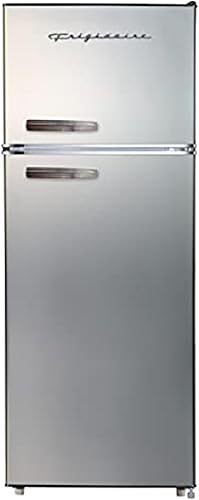
Once your slot measurements and configuration are set, comparing a few proven models beats scrolling endless listings. For the tightest budgets and second-fridge duty, the Frigidaire EFR753 packs a usable 7.5 cubic feet of top-freezer storage into a small footprint and is backed by hundreds of reviews. If you want fresh-food room and keep frozen goods elsewhere, the single-door Frigidaire EF756MNT earns strong ratings across a few hundred buyers. Need more capacity without going full-size? The BLACK+DECKER BUC1700XB offers around 17 cubic feet and shows notably steady monthly demand, while the Frigidaire FRQG1721AV is a well-reviewed step up. Use these as anchors, then see how they stack up against the rest of our ranked picks.
Frequently asked questions
What size refrigerator is best for a small kitchen or apartment?
For one or two people, a compact fridge in the 7 to 12 cubic foot range is usually ideal. A 7.5 cubic foot top-freezer fits most apartment kitchens while still holding a week of groceries. Size to your real shopping habits and the width of the gap, not to the largest unit that could squeeze in.
Is a top-freezer or a single-door fridge better for a small space?
A top-freezer is the most space-efficient all-in-one choice and keeps both fresh and frozen food in one footprint. A single-door upright fridge maximizes fresh-food room and suits anyone who already owns a separate freezer or rarely freezes. Choose based on whether you need on-board freezing.
Why does counter-depth matter in a small kitchen?
Counter-depth models sit nearly flush with your cabinets so the fridge doesn't stick out into an already narrow walkway. You give up a little interior volume, but in a tight room the flush profile and easier traffic flow are usually worth more than the lost cubic feet.
How much clearance does a small refrigerator need?
As a general rule, leave roughly an inch of air on each side and a couple of inches at the back so the compressor can shed heat. Always check the model's own spec sheet, since cramming a fridge into a tight nook with no airflow makes it run louder, work harder and cool less reliably.