What Size Kegerator Do I Need?
Pick the right kegerator size by matching keg type, tap count, and footprint to how much you actually pour.
The honest answer to "what size kegerator do I need" is that it depends on two numbers: how big a keg you want to chill and how much room you have to put it. Most home kegerators are built around a single full-size half-barrel, but plenty of people would be better served by a slim unit holding one or two smaller kegs. Get the match wrong and you either fight a lid that won't close or you pay to cool empty air.
This guide walks through the keg sizes you can actually buy, how tap count changes the math, and the footprint difference between freestanding and built-in models. By the end you'll know which size class fits, so you can shop our kegerator picks with a clear target instead of guessing.


Start With the Keg, Not the Cabinet
Kegerator capacity is really keg capacity. In the U.S. the common sizes are the half-barrel (often called a full-size keg, roughly 15.5 gallons), the slim quarter-barrel or "tall quarter," the sixth-barrel sixtel (about 5.2 gallons), and the small Cornelius (Corny) kegs popular with homebrewers at around 5 gallons. A standard home kegerator is sized to swallow one half-barrel. If you mostly drink craft beer that ships in sixtels, or you keg your own brew in Corny kegs, you can run two or even three smaller kegs in the same cabinet a single half-barrel would fill. Decide what you'll actually fill it with first, then size the box around that.
How Many Taps Do You Want?
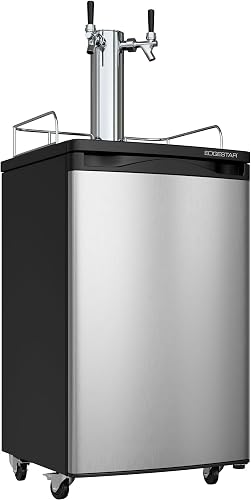
Tap count drives size as much as keg volume does. A single-tap kegerator keeps one beer cold and is the simplest, cheapest, most space-efficient choice. A dual-tap or twin model lets you run two different beers at once, which is the sweet spot for households that like variety or a beer-plus-cider setup. Once you go to triple taps you're usually committing to several small kegs inside one larger cabinet and a wider footprint to match. More taps also means more CO2 distribution hardware inside, which eats a little interior room, so don't assume a dual-tap holds exactly twice the beer of a single.
Freestanding vs. Built-In Footprint
Where the unit lives changes the dimensions you should shop for. Freestanding kegerators vent heat from the back or sides and need a few inches of clearance, so the real footprint is bigger than the cabinet alone. Built-in (front-venting) models are designed to slot under a counter or into cabinetry flush with the surrounding fronts, which matters if you're planning a bar or outdoor kitchen. Measure the opening height, width, and depth, then subtract clearance for venting and the rear gas lines before you trust a spec sheet. A unit that fits the hole but can't breathe will run warm and short its compressor life.
Match Size to How Much You Actually Pour
A half-barrel holds roughly 124 pints. If you pour a few beers on weekends, that keg can sit tapped for weeks, and a big single-tap full-size unit is plenty. If you host often or want two styles on hand, a dual-tap running two sixtels gives you variety and turns the kegs over before they go flat. Light, occasional drinkers are usually happiest with a compact single-keg unit that doesn't dominate the room or the power bill. Be honest about pour volume rather than buying for the one party a year, and you'll land on a size you use, not one you babysit.
Indoor, Garage, or Outdoor Placement
Placement quietly narrows your size choices. An indoor kitchen or basement bar gives you the most flexibility on dimensions and venting. A garage means you should confirm the unit is rated to keep cold in a wide ambient temperature swing, since a standard kegerator can struggle to hold serving temperature in heat. Outdoor and patio installs call for a model specifically built for outdoor use with weather-resistant housing. The point: don't size on capacity alone, because the spot you've chosen may rule out certain cabinet styles before keg count ever enters the picture.
Don't Forget the CO2 and Clearance
Internal versus external CO2 changes usable space. Many home kegerators tuck a small CO2 cylinder inside the cabinet, which trims the room available for the keg itself, so a unit advertised for a full-size keg may be tight once the tank is in place. Larger or multi-tap setups often move the CO2 outside the cabinet, freeing interior space but adding to the footprint behind or beside the unit. When you compare sizes, look at stated keg compatibility rather than raw cubic feet, and leave headroom above the keg for the coupler so the lid actually closes.
Quick Sizing Cheat Sheet
Use this as a starting filter. Casual drinker, limited space: compact single-tap holding one small keg. One beer at a time, regular use: standard single-tap sized for a half-barrel. Variety lover or frequent host: dual-tap running two sixtels or two smaller kegs. Homebrewer with Corny kegs: a cabinet that fits two to three 5-gallon kegs. Building it into a bar or outdoor kitchen: a front-venting built-in or outdoor-rated model measured to the opening. From there, our kegerator picks are grouped so you can jump straight to the size class that fits.
Frequently asked questions
What size keg fits in a standard kegerator?
Most standard home kegerators are built to hold one full-size half-barrel keg, roughly 15.5 gallons. The same cabinet can usually fit two smaller sixth-barrel (sixtel) or Cornelius kegs instead, which is how dual-tap setups work.
Is a single-tap or dual-tap kegerator better?
A single-tap is cheaper, more compact, and ideal if you keep one beer on at a time. A dual-tap lets you pour two different beers at once and turns smaller kegs over faster, making it the better pick for variety or frequent entertaining.
Do I need a freestanding or built-in kegerator?
Freestanding models vent from the back or sides and need clearance, so they suit open floor spots. Built-in (front-venting) models are designed to sit flush under a counter or in cabinetry, which is what you want for a bar or outdoor kitchen install.
Can I put a kegerator in my garage?
You can, but confirm the model is rated for the temperature swings a garage sees. A standard kegerator may struggle to hold serving temperature in summer heat, so a unit built for wide ambient ranges is the safer choice.